
Listening to the Edges
Sonic Memory, Territory, and Acoustic Ecology in Baja California
Listening to the Edges. Baja California is one of the most ecologically diverse territories on the continent. Within a few hours, the landscape shifts from the Pacific Ocean to a mountain range rising 2,800 meters above sea level, and onward to the desert shores of the Gulf of California. Yet these ecosystems lacked any systematic acoustic record.
Listening to the Edges is a sound research-creation project that documents, analyzes, and composes from the acoustic landscapes of three ecosystems in Baja California: the Pacific coast, the Sierra de San Pedro Mártir, and the Gulf of California. The edge is not merely the subject — it is the condition of listening.
The Ecosystems
Pacific Coast — Ensenada
Edge of the continent. Continuous surf, coastal wind, gray whale migration route, and migratory bird corridors. A priority marine region.
Sierra de San Pedro Mártir
Interior edge. A National Park since 1947. Dense silence, nocturnal fauna, presence of the California condor, and exceptional conditions for listening due to minimal light and noise pollution.
Gulf of California — San Felipe
Liminal edge between sea and desert. A territory of vast biological and acoustic diversity, where surf, wind, marine fauna, and desert landscape coexist.
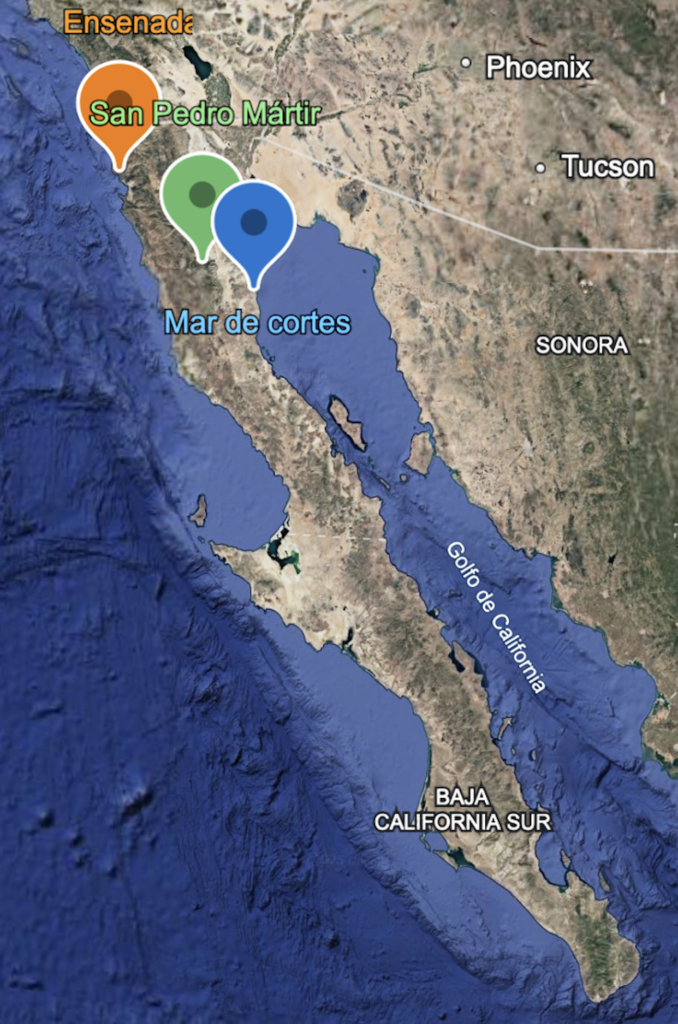
PACIFIC COAST
ENSENADA
SIERRA SAN
PEDRO MARTIR
GULF OF CALIFORNIA
SAN FELIPE
Methodology
The working process follows a sequence that integrates phenomenological listening with quantitative analysis:
Extended listening → Soundwalk → Field recording (Zoom H5, WAV format, 24-bit/48 kHz) → ACI/ADI acoustic index analysis in RStudio → Electroacoustic composition with minimal intervention.
The numbers do not replace listening — they anchor it.
| Ecosystem | ACI | ADI |
|---|---|---|
| Pacific | 1,775 | 0.72 |
| Sierra | 1,900 | 0.07 |
| Gulf | 1,951 | 1.18 |
The acoustic indices reveal profound differences among the ecosystems: an ADI of 0.07 in the Sierra de San Pedro Mártir indicates a landscape dominated by a single frequency band (dense silence punctuated by sporadic fauna), while the Gulf’s ADI of 1.18 reflects acoustic activity distributed across the full spectrum (surf, wind, marine and desert fauna occurring simultaneously).

Theoretical Framework
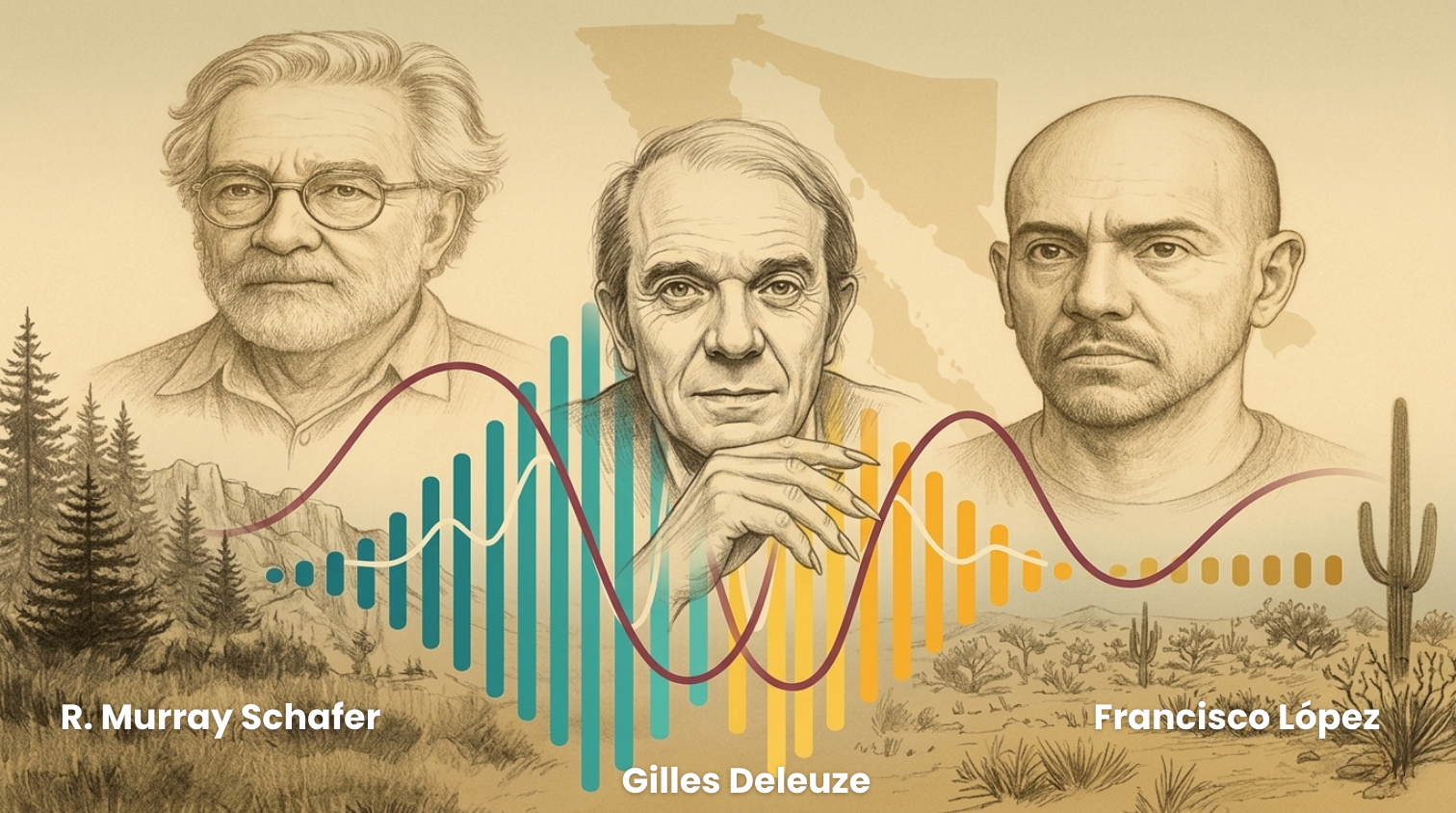
Three voices sustain this project.
R. Murray Schafer proposes that the soundscape is the imprint of the relationship between living beings and their environment. To listen to a territory is to read it: to measure its health, to recognize its memory.
Francisco López takes listening beyond representation. Sound does not merely reflect the world — it creates its own. Listening ceases to be a form of recording and becomes an autonomous experience.
Gilles Deleuze conceives of the edge not as a fixed line, but as a zone of transformation: the space where something ceases to be what it was and has not yet become what it will be. Difference, repetition, becoming.
In Listening to the Edges, these three perspectives converge: the soundscape as document, listening as experience, and the edge as the site where both transform one another. To listen to the territory is at once to know it, to inhabit it, and to activate its memory.
THE SOUND PIECES
The sound pieces and field recordings derived from this project bring together listening, analysis, and composition from three ecosystems in Baja California. Each fragment functions both as an acoustic document and as an aesthetic experience of situated listening.
PACIFIC
ENSENADA
ACI 1,775
ADI 0.72
SIERRA SAN
PEDRO MARTIR
ACI 1,900
ADI 0.07
GULF
SAN FELIPE
ACI 1,951
ADI 1.18
Methodological note: The ACI and ADI indices are obtained by processing WAV recordings in RStudio using the soundecology package, which analyzes the spectrogram of each file. The ACI measures sonic complexity; the ADI measures the diversity of active frequency bands.
SONIC HERITAGE:
Baja California does not have a systematic acoustic archive of its ecosystems. These recordings constitute a baseline record — a reference point that enables the observation of environmental transformations and the preservation of a sonic memory of the territory. To document how a place sounds today is to preserve information that cannot be reconstructed later.
Why Now?
Some of these landscapes are fragile. If they are not documented now, there will be no basis for comparison to hear how they change in 10, 20, or 50 years. This sound archive proposes a form of territorial memory before the irreversible transformation of the environment.
About the Researcher
This research was published in PRAGMA (Benemérita Universidad Autónoma de Puebla), Vol. 04, No. 08, April–September 2026, pp. 125–144. The article documents the field recording methodology, the analysis of acoustic indices ACI/ADI, and the compositional process developed across the three ecosystems.
The field recordings produced through this project are part of the Mapa Sonoro de México collection held by the Fonoteca Nacional, where they are archived under the hashtag #EscuchandoLosBordes.
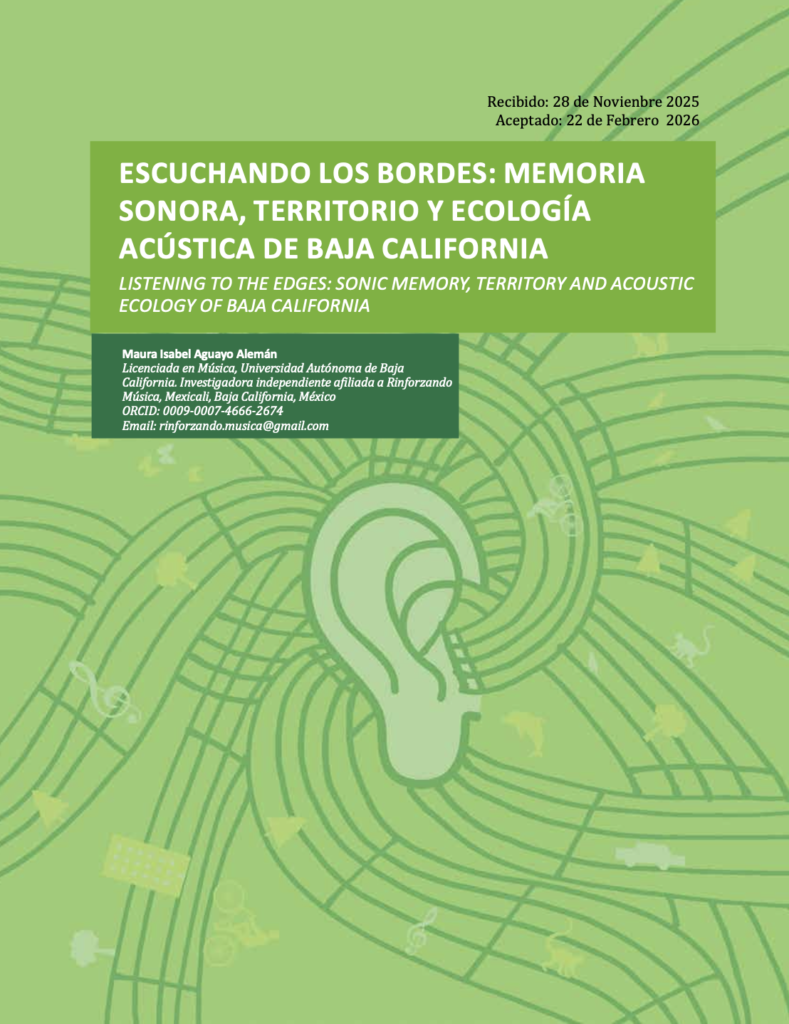
PECDA BC 2026 · Young Creation
Escuchando los Bordes was selected as a supported project by the Program for the Stimulation of Artistic Creation and Development of Baja California 2026 (PECDA BC), in the Young Creation category, discipline Audiovisual and Alternative Media. Results published on June 11, 2026 by the Secretaría de Cultura of the Government of Baja California.
The grant will support a sound expedition across five new ecosystems in the state : Valle de los Cirios, Parque Nacional Constitución de 1857, Puertecitos, Bahía de los Ángeles, and Humedales de Bahía San Quintín and the composition of a series of five electroacoustic pieces structured as an extended work. The series will be published in open access and presented at an institutional venue in Baja California in 2027.
About the Researcher
Maura Isabel Aguayo Alemán is a sound artist, researcher, and music educator. She holds a degree in Music from the Universidad Autónoma de Baja California (UABC) and has directed Rinforzando Música since 2017 an independent platform for sound creation, research, and music education based in Mexicali, Baja California.
She has presented Listening to the Edges at the Centro Cultural Tijuana (CECUT), as part of the Sound Art and Multimedia Program at CENDOART, as well as at the Second International Colloquium on Soundscape organized by the Ibero-American Network URBS SONORUM. Her work has been published by the Centro Nacional de Investigación, Documentación e Información Musical (CENIDIM) of INBAL, the Italian journal THULE, RIO-LATIR of CIESAS, and Feminopraxis and in PRAGMA (Benemérita Universidad Autónoma de Puebla).
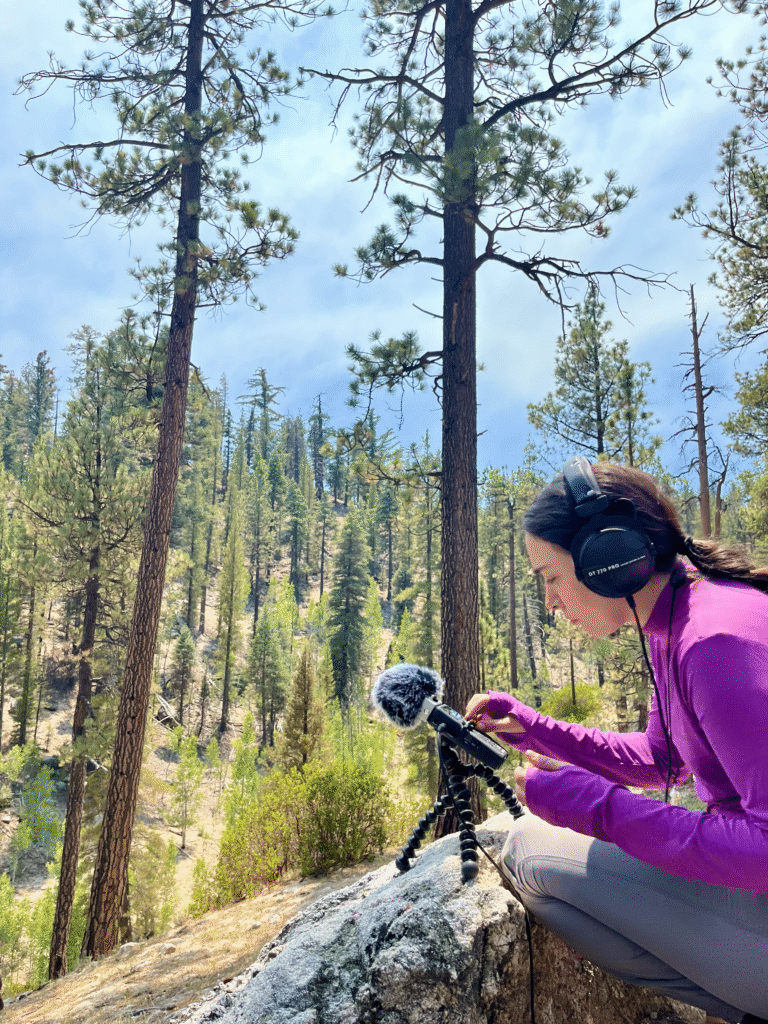
Conference Papers and Academic Presentations
Maura Alemán has presented her research in academic, artistic, and institutional spaces dedicated to sound art, acoustic ecology, memory, territory, and listening.
Sound Art and Territorial Memory (2026)
| Talk and listening session | “Escuchando los Bordes: Memoria, Territorio y Ecología Acústica en Baja California” (Listening to the Borders: Memory, Territory, and Acoustic Ecology in Baja California) |
| Program: | Sound Art and Multimedia. |
| Organized by: | Centro de Documentación de las Artes (CENDOART), through the Centro Cultural Tijuana (CECUT), Secretaría de Cultura |
| Venue: | Video Room, Centro Cultural Tijuana (CECUT), Tijuana, Baja California |
| Date: | March 21, 2026. |
| Keywords: | sound art, acoustic ecology, sonic memory, territory, listening, Baja California. |
Listening to the Borders (2025)
| Presentation: | “Escuchando los Bordes: Memoria, Territorio y Ecología Acústica en Baja California” (Listening to the Borders: Memory, Territory, and Acoustic Ecology in Baja California) |
| Event: | Second International Colloquium on Soundscape: Public Space and Citizenship in Historic Centers |
| Organized by: | Universidad Michoacana de San Nicolás de Hidalgo (UMSNH), Universidad Autónoma Metropolitana (UAM) Azcapotzalco, Benemérita Universidad Autónoma de Puebla (BUAP), and the National Council for Humanities, Sciences, and Technologies (CONAHCYT), in collaboration with the Ibero-American Network URBS SONORUM |
| Venue: | Center for Information, Art, and Culture, Universidad Michoacana de San Nicolás de Hidalgo (UMSNH) |
| Keywords: | sound art, territory, acoustic ecology, research-creation |
The Tecciztli and Ancestral Sonorities (2020–2021)
| Presentation: | “El tecciztli o trompeta de caracol y su uso recurrente en los rituales de sacrificio humano de las veintenas mexicas” (The Tecciztli or Conch Shell Trumpet and Its Recurrent Use in Human Sacrifice Rituals of the Mexica Veintenas) |
| Event: | National Forum on Music Research and Documentation |
| Organized by: | Centro Nacional de Investigación, Documentación e Información Musical (CENIDIM) / Instituto Nacional de Bellas Artes y Literatura (INBAL). |
| Venue: | Centro Nacional de Investigación, Documentación e Información Musical (CENIDIM) |
| Keywords: | musicology, sonic heritage, prehispanic cosmogony |
Ethnomusicological Encounters Series (2020)
| Presentation: | The Tecciztli |
| Event: | Ciclo de Encuentros Etnomusicológicos “Hablando de Instrumentos Musicales” (Ethnomusicological Encounters: Discussing Musical Instruments). Participation in the panel “Tecciztli – Drum – Atabaque – Electronic Percussion” |
| Organized by: | G.R.E.C.A Gruppo di Ricerca en Etnomusicologia Circolo Amerindiano (Italy) |
| Coordination: | María Lina Picconi. |
| Keywords: | ritual instruments, Afro-Latin American percussion, sonic heritage, comparative ethnomusicology |
Listening and Migration (2017–2018)
| Presentation 1: | El movimiento migratorio haitiano visto a través de su escucha” (Haitian Migration Through the Lens of Listening) |
| Event: | II Congress of Ethnomusicology: “Cuerpos sonoros: música, experiencia estética y praxis social” (Sounding Bodies: Music, Aesthetic Experience, and Social Praxis) |
| Organized by: | Universidad Nacional Autónoma de México (UNAM). |
| Venue: | Faculty of Music, UNAM |
| Temas: | migration, cultural identity, Haitian music in Mexico |
| Presentation 2: | “Del raboday al kompa: la música de los migrantes haitianos en Baja California” (From Raboday to Kompa: The Music of Haitian Migrants in Baja California) |
| Event: | Congress “Northern Mexico and the Southern United States: Fluid Spaces for Post-Global Processes” |
| Organized by: | Mexican Society of Anthropology |
| Venue: | Ensenada Baja California |
| Keywords: | migration, cultural identity, border musical practices |
Research Lines
Sound Research & Sonic Practice – Maura Alemán
Throughout her career, the author’s research has developed around four thematic axes that engage in dialogue with one another: the ancestral, the migratory, the territorial, and the educational. These axes represent distinct moments and shifts within her research-creation practice, configuring a framework that articulates collective memory, territory, listening, and independent music pedagogy.
- The ancestral: sound as cosmogonic and spiritual force
- The migratory: listening as memory in movement
- The territorial: soundscape as living archive of the environment
- The pedagogical: independence as creative and pedagogical act
Across all of them, listening serves as a common thread that transforms sound into a form of memory, resistance, and contemporary creation.
🇪🇸 Para leer esta información en español, haz clic aquí.