
Commitment to Research and Musical Culture
At Rinforzando Música, the commitment to music education goes hand in hand with research and critical reflection — a vision driven by its founder Maura Alemán, sound researcher, violist/violinist, educator, and sound artist.
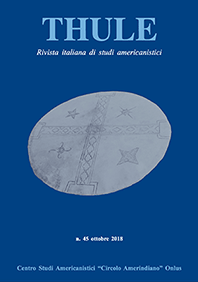
Through this approach, part of the work of Rinforzando Música and Maura Alemán has been published in highly recognized academic and cultural venues. Among them is the international journal THULE – Rivista italiana di studi americanistici, dedicated to the study of the Americas from a transdisciplinary perspective.
Additionally, Maura Alemán’s research on the tecciztli—a conch shell trumpet used in Mexica rituals—was published in the digital repository of the Instituto Nacional de Bellas Artes y Literatura (INBAL), as part of a project supported by Mexico’s Ministry of Culture.
Her work also explores sound performance in border contexts, the acoustic ecology of Baja California, and critical reflections on gender and pedagogy in publications such as Río Latir and Feminopraxis.
“El Tecciztli o Trompeta de Caracol: Su Función Ceremonial y Cosmogónica entre los Aztecas” (The Tecciztli or Conch Shell Trumpet: Its Ceremonial and Cosmogonic Function among the Aztecs)
Thule Rivista italiana di studi americanistici
Abstract
The tecciztli or conch shell trumpet is one of the most evocative musical instruments of prehispanic Mexico and one of the most emblematic of contemporary Mexicanist movements. The symbolic significance of this instrument, however, remains little known. This article documents this significance and investigates:
- The role the tecciztli played in sacrificial ceremonies conducted by the Aztecs throughout 17 of the 18 veintenas that structured their solar calendar.
- The role assigned by the ancient Mexica to this instrument within their cosmogony.
- The iconographic representation of the tecciztli in the codices of this civilization.
This study demonstrates that the tecciztli inhabited a liminal space between the underworld and the upperworld, and was the medium used by Aztec divinity to create Quetzalcoatl and humankind.
In this sense, the tecciztli was considered the generator of the “divine breath” which, when used to announce the death of the sacrificed, could be regarded as the medium par excellence for connecting the origin of life with death.
Due to its polysemic nature, the sound produced by the conch shell trumpet was represented by the Aztecs with the same sign used to represent divine breath, the word, song, poetry, and music.
conch shell trumpet, Mexico, Quetzalcoatl
The Tecciztli or Conch Shell Trumpet and Its Recurrent Use in Human Sacrifice Rituals of the Mexica Veintenas
Secretaría de Cultura, INBAL, Cenart, Cenidim
Abstract: The tecciztli, a trumpet made from a marine conch shell, played a crucial role in human sacrifice rituals during the Mexica veintenas—the ceremonial cycles of the religious calendar. Its deep, resonant sound not only marked specific moments within the ritual but also served as a medium to invoke deities, spiritually prepare participants, and connect the human and divine worlds.
Used especially in ceremonies dedicated to gods such as Tláloc and Tezcatlipoca, the tecciztli symbolized communication between sky, earth, and the underworld. Its presence reaffirms the importance of sound in prehispanic religious practices—not merely as accompaniment, but as an active element that shaped the sacred experience.
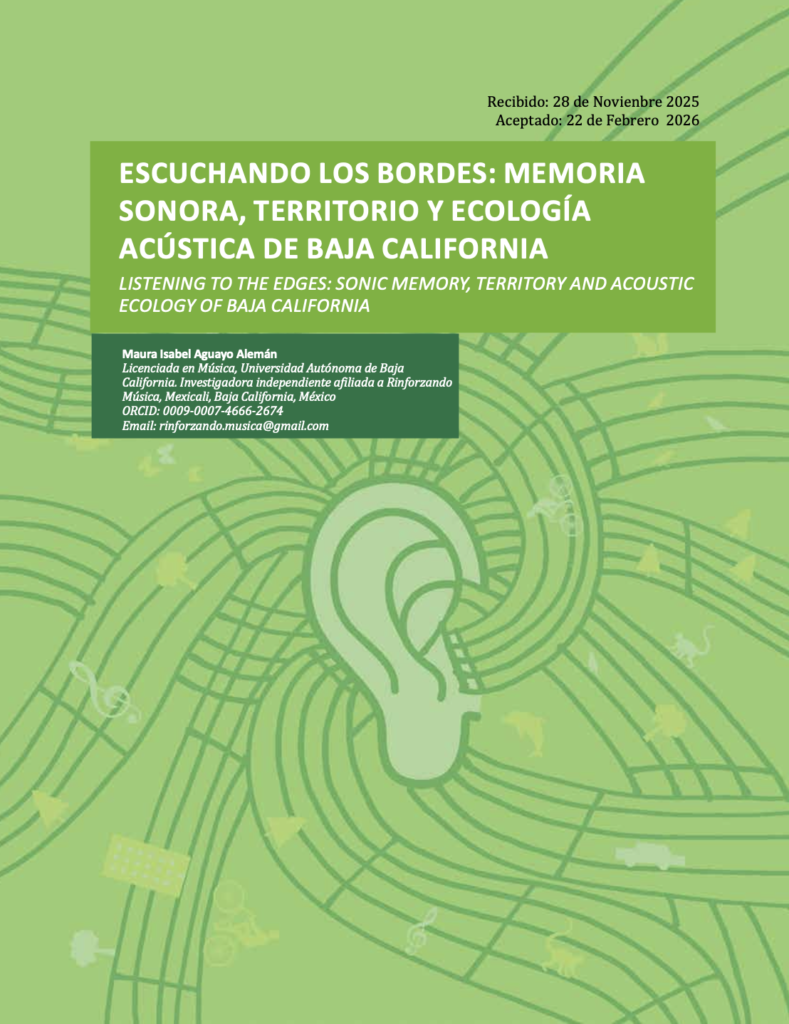
LISTENING TO THE EDGES: SONIC MEMORY, TERRITORY AND ACOUSTIC ECOLOGY OF BAJA CALIFORNIA
PRAGMA / Meritorious Autonomous University of Puebla – BUAP
Abstract
This sound-based research-creation project explores the geographic borders of Baja California through situated sonic work across three territories: the Pacific, the Sierra de San Pedro Mártir, and the Gulf of California. Using an interdisciplinary approach that integrates acoustic ecology, sound art, and territorial thought, the project proposes listening as a form of knowledge capable of generating environmental memory and resistance within a context of rapid territorial transformation. The methodology combines field recordings using a Zoom H5, the practice of soundwalking, and minimal post-production, allowing the natural dynamics and spatiality of each environment to emerge. These practices are complemented by the calculation of acoustic indices (ACI and ADI) in RStudio to quantitatively characterize the resulting pieces. From this process, sound pieces are composed that translate territorial experience into listening-based works, creating an unprecedented sonic archive that reveals the acoustic diversity of three contrasting ecosystems: sea, mountain, and desert. The research draws on R. Murray Schafer, Francisco López, and Gilles Deleuze, positioning the “border” as a space of becoming where sound transforms both territorial memory and the listener’s perception. This sonic ecology understands listening as a practice of knowledge, transformation, and memory.
Performance at the Mexicali (Mexico)–Calexico (United States) Border
This project consisted of a triple documentation—photography, audio, and video—of a performance carried out at the border between Mexicali (Mexico) and Calexico (United States). Through the violin, I sought to embody and physically experience the process of migration, placing the instrument—a symbol of European academic music—in a border and unconventional context, to explore how body and sound can reveal new ways of listening to and understanding the migrant experience.

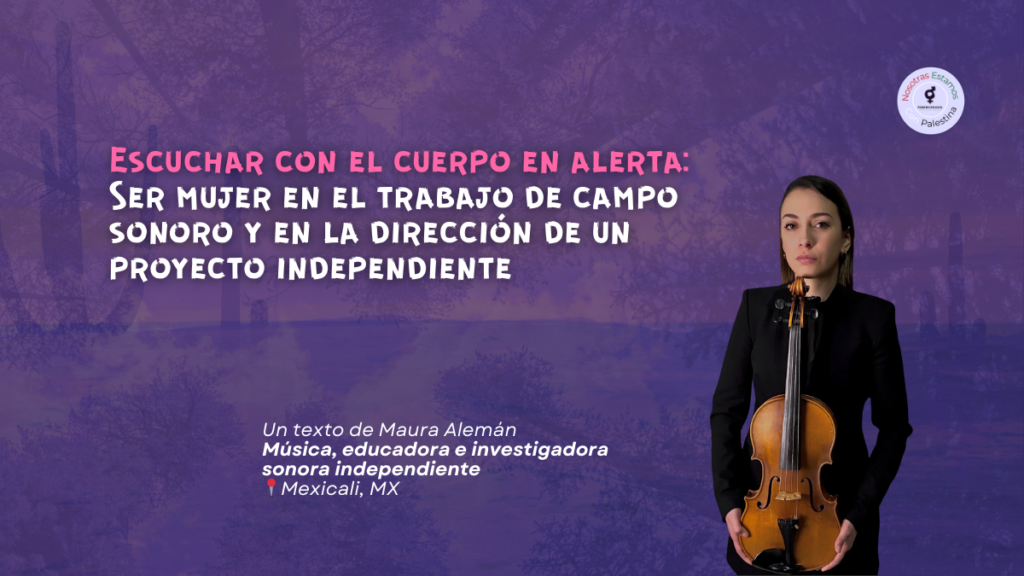
Listening with the Body on Alert: Being a Woman in Sound Fieldwork and in Leading an Independent Project
FEMINOPRAXIS – Ars Feminista / Music
Abstract: This essay reflects on the gendered implications of sound fieldwork and the direction of independent cultural projects. Drawing from her experience documenting the soundscapes of Baja California—the Pacific coast, the Sierra de San Pedro Mártir, and the Gulf of California—Maura Alemán examines how listening in the field involves, for women, a constant negotiation with the body: calculating exit routes, assessing available daylight, evaluating risks that methodological handbooks fail to name.
The text also addresses the “credibility tax” women face when leading independent projects, and how the founding of Rinforzando Música in 2017 responds to the need for spaces where musical learning becomes a site of care rather than judgment. Grounded in the pedagogies of Paulo Freire, bell hooks, and Nel Noddings, this practice positions listening as an act of resistance: refusing haste, reclaiming the right to be present, and building spaces where others need not pay the same cost.
🇪🇸 Versión en español: Para leer sobre mis publicaciones en español, haz clic aquí.